
Our process · Step 4 of 6
Hand decoration
Hand-finished lithographing, banding and gilding – the craft behind our decorated ware. Every transfer, band and gold line is applied by hand by our experienced team.
Our techniques
Three ways we decorate your ware
Lithographing
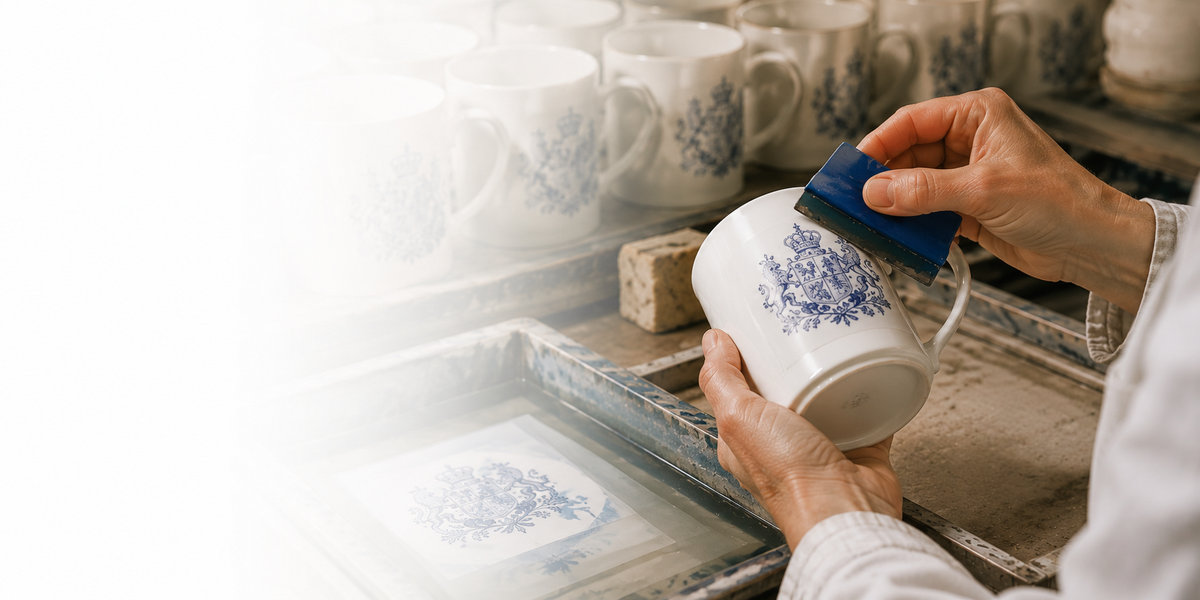
Printed waterslide transfers placed onto the ware by hand. Our lithographing team has over 20 years of experience.
Banding
Fine lines of colour or precious metal painted by hand around the rim or body. Our bander has over 30 years of experience.
Gilding
Real gold and platinum lines, bands and patterns – a hallmark of luxury ceramics.
Technique 1
Lithographing
In the Potteries, lithographing is the traditional name for applying printed ceramic transfers (also called decals or "lithos") to the ware. Your design is printed in our own print room onto waterslide transfer paper, then each transfer is applied to the china by hand.
The beauty of lithographing is that each transfer is hand placed, relying on human precision rather than machine placement – which is what makes each piece we produce extra special.
- Over 20 years of experience in our lithographing team
- Every transfer is positioned and rubbed down by hand
- Applied using waterslide transfer paper, then kiln fired
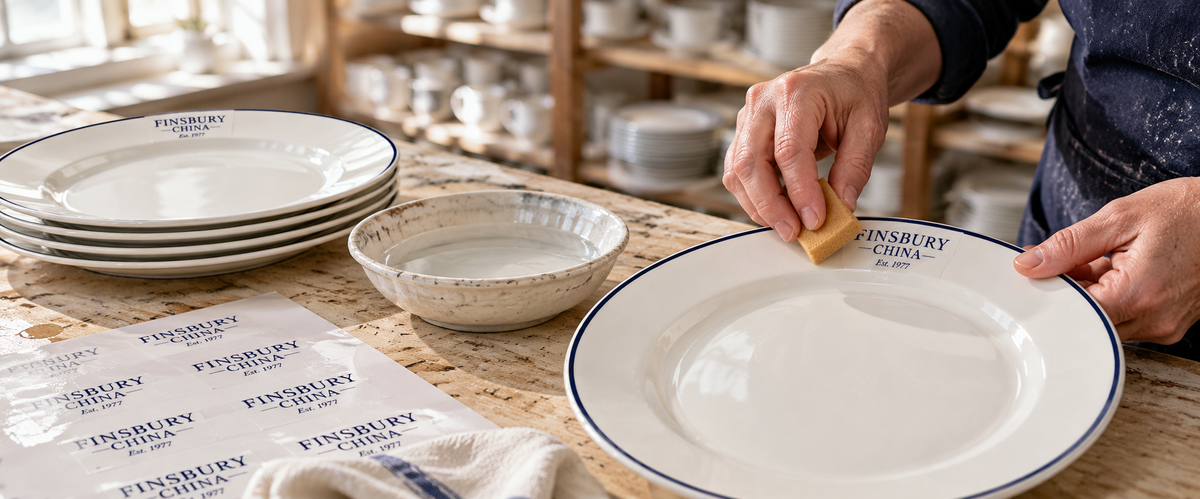
How a transfer is applied
01
Soak
The transfer is soaked in water so the backing paper absorbs it and loosens the adhesive.
02
Slide
The decal is slid off the backing paper onto the ceramic surface.
03
Smooth
It's rubbed down by hand to remove wrinkles and any air or water trapped underneath.
04
Dry
The transfer is left to dry completely.
05
Fire
The ware is fired in a kiln to fuse the pigment into the glaze.
Decorating your own?
We can supply printed transfers for you to apply yourself. See the step-by-step guide and firing temperatures on our Printing page.
Technique 2
Banding
Banding on fine bone china is the decorative process of applying one or more concentric lines (bands) – often metallic, such as gold or platinum, or coloured – around the rim or body of plates, cups and mugs. It's a classic embellishment that adds elegance and refinement to the finished ware.
It takes a lot of skill and precision. Each item is hand painted, so there will be slight variance – which adds to the bespoke, hand-crafted artistry of every piece.
- Painted by hand on a banding wheel
- Gold, platinum or coloured bands
- Our bander has over 30 years of experience
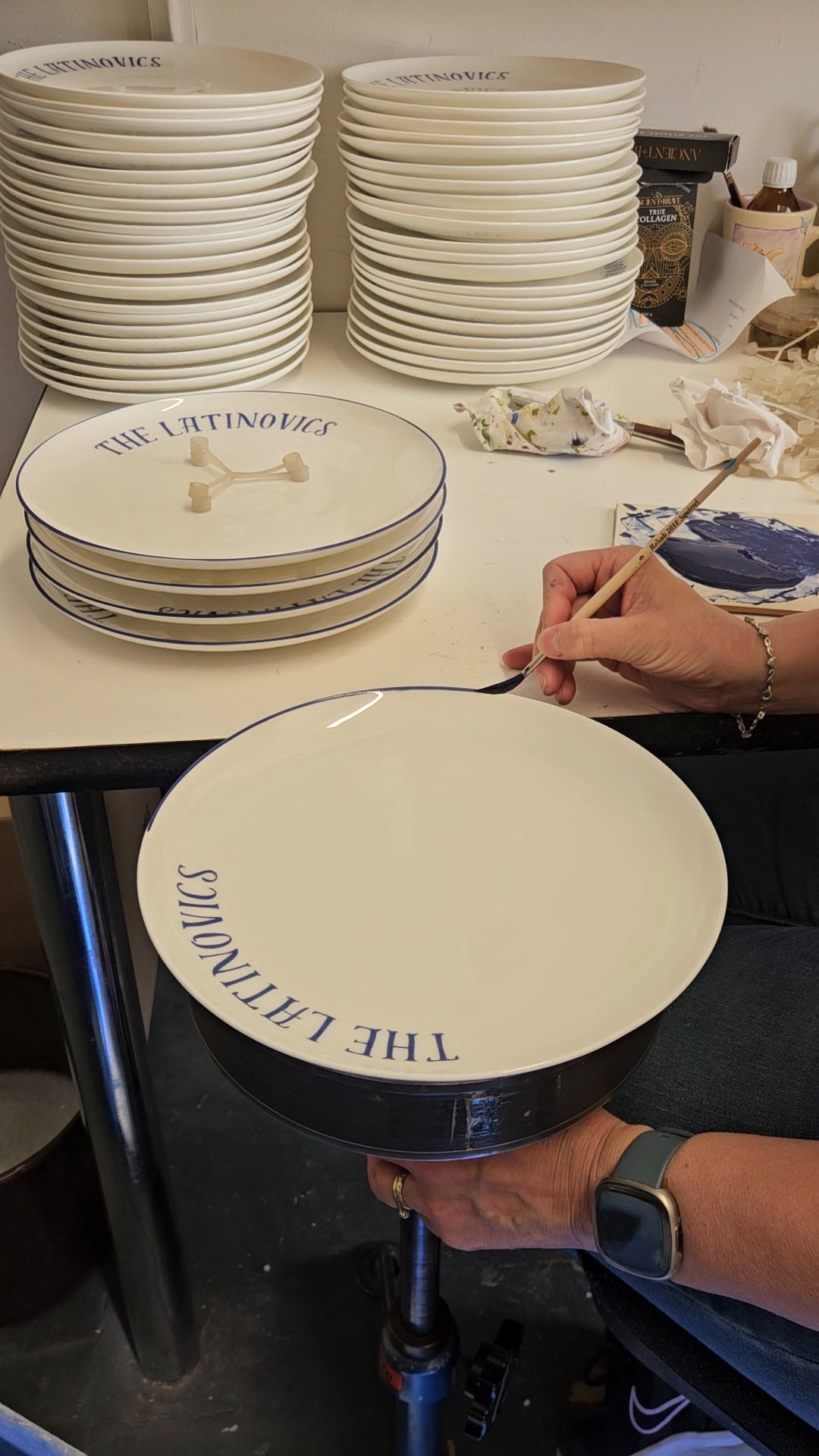
Hand banding, step by step
01
Load the brush
A brush, usually squirrel or sable hair, is dipped in metallic or enamel paint.
02
Spin
The item spins on a banding wheel.
03
Paint
The decorator holds the brush steadily against the surface to create smooth, even lines.
Technique 3
Gilding
Gilding fine bone china is the process of applying real gold decoration – often as fine lines, bands, patterns or full designs – onto the surface of glazed and fired china. It's a hallmark of luxury ceramics, especially tableware, ornamental and commemorative pieces.
It's essentially the same process as banding, but with metallic colours. Because we use real gold and platinum, it's a more expensive process.
- Real gold and platinum
- Fine lines, bands, patterns or full designs
- Ideal for tableware, ornamental and commemorative pieces

Caring for gilded ware
- Gilding is delicate – it isn't dishwasher or microwave safe.
- For longevity, hand-wash with a non-abrasive cloth.
- Gold can wear off over time if it's subjected to regular friction.
Hand-made, not machine-made
What to expect from hand decoration
Once printed, waterslide transfers are soaked to release them from their backing paper, then applied to the ware entirely by hand. Each transfer is positioned, then rubbed down by hand to remove any trapped air or water and flatten it fully against the surface, ready for firing.
Because this is a genuinely manual, skilled process – not a mechanised one – a small degree of natural variation between individual pieces is normal and should be expected, particularly on curved or handled ware.
Variations that can occur
Positioning
Slight misalignment or positioning variance between individual pieces within the same order.
Edges and curves
A transfer may not lie perfectly flat, occasionally leaving a sliver of bare ware visible at an edge, or making text or fine linework look very slightly stretched or wavy where it has been worked around a curve or handle.
Wrap-around designs
On designs that wrap fully around a curved piece, the curve itself can make straight text appear to slant, even when it has been applied correctly.
Our standard
We hold our decorators to a consistent standard, but minor variation of this kind falls within normal, acceptable tolerance for hand-decorated ceramics and isn't considered a fault. Where an order is colour- or position-critical, we recommend approving a proof before the full run goes into production.
Good to know
Decorating FAQs
Will every piece look identical?
Every piece is decorated by hand, so expect slight natural variation in positioning and line work between pieces. This is part of the hand-crafted character of fine bone china and falls within normal tolerance.
Is decorated ware dishwasher and microwave safe?
Fired transfers are set into the glaze and are dishwasher and microwave safe, providing the ware itself is. Gilded decoration (real gold and platinum) is not dishwasher or microwave safe and should be hand-washed.
Do you use real gold?
Yes. Our gilding uses real gold and platinum, which is why it's a more expensive process than coloured banding.
Can I apply the transfers myself?
Yes. We can supply printed transfers for you to decorate yourself – see our Printing page for the step-by-step guide and firing temperatures. Or our team can decorate and fire them for you.
Ready to start?
Get a free mockup & quote →
Have a design in mind?
Send us your artwork and our team will come back to you with a free mockup and quote.